The market for renewable energy certificates in Australia is currently in freefall. Prices are dropping like a stone, making the cost of being green much cheaper for your retailer. Make sure it gets cheaper for you, too.
The Australian Energy Market Commission (AEMC) is officially starting its Accelerating Smart Meter Deployment (ASMD) reforms. If you don’t already have a smart meter, you will by the end of 2030.
We're on the cusp of seeing new supply entering the market, and we're also seeing plateauing and falling demand. That can mean only one thing, electricity rates will head south. The question is, when will you start to see that reflected in your own bill?
We've been seeing price increases across the Australian electricity markets for so long that it feels like that's the only way things can go.
But energy pricing is subject to the same principles of supply and demand as any other product or service. We're on the cusp of seeing new supply entering the market, and we're also seeing plateauing and falling demand. That can mean only one thing, electricity rates will head south. The question is, when will you start to see that reflected in your own bill?
Retailers will move at their own speed to pass on these savings, and the slower they act the more profitable their retail business...
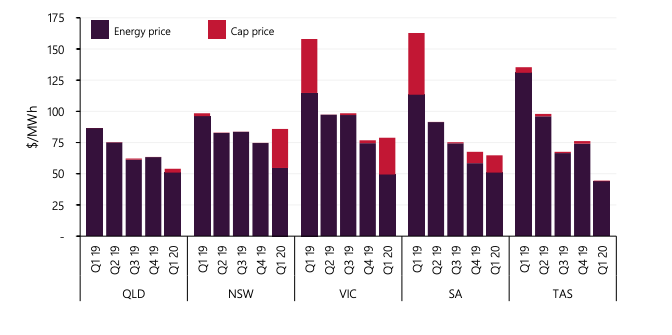
The Australian Energy Market Operator (AEMO) publishes the Quarterly Energy Dynamics report. For Q1 2020 it shows that average wholesale electricity prices were down a whopping 49% vs Q1 of 2019. This represents the lowest quarterly average price since Q4 2016.
Average wholesale electricity price by state - prices are down across the entire National Electricity Market
AEMO identified four main drivers of this price decrease:
Lower gas prices - Gas is a significant influence on electricity pricing, since gas is used for 'peaking' generation to provide energy when demand is high. Lower gas prices also influence market bids from other fuel types such as hydro and black coal-fired generation.
Reduced demand - Compared to Q1 2019, increased rooftop PV output and mild weather in the second half of the quarter substantially reduced average daytime demand.
Lower offered prices from black coal-fired and hydro generation - In Q1 2020, there was a material shift in price offers from black coal-fired generation and hydro generation compared to Q1 2019. These shifts coincided with lower gas prices, reduced demand, and increased renewable output.
Increased wind and solar output - Compared to Q1 2019, combined grid-scale wind and solar output increased by 551 MW due to the ramping up of new capacity entering the system.
WHAT'S COMING FOR THE WHOLESALE MARKET?
There is no crystal ball for energy pricing, but the electricity futures market gives us the best insights into expected price changes. The price of electricity futures contracts continued to decline during Q1 2020, with Calendar 2021 future prices finishing the quarter at multi year lows across all regions. These futures price reductions were influenced by lower spot electricity and gas prices, expectations of further increases in renewables and rooftop PV, and concerns about the impact of COVID-19 on demand.
ASX Energy – Cal21 swap prices by region, seven day averages
WHAT DOES IT MEAN FOR THE RETAIL MARKET?
Wholesale price reduction is all well and good, but Bill Hero subscribers are interested in retail prices.
Wholesale generation costs typically represent only about 10% - 20% of your retail bill. So even though wholesale prices came down nearly 50% in the last quarter, this does not imply we can expect the same reduction in retail prices. What we can expect is up to about 15% average reduction to retail bills, assuming that the full benefit of the wholesale price reduction is passed through to retail prices.
In an efficient market, this is what you'd expect to happen, we'll see how it plays out in the Australian retail electricity confusopoly market.
WHAT DOES IT MEAN FOR YOU?
With the wholesale rates coming down, it's more important than ever to stay on top of your electricity bills and make sure you get the maximum benefit as soon as possible. Retailers will decide if and when to pass through the price reductions at different times, so it may make sense to switch more than once over the coming months to make sure you get the best benefits.
That's boring and hard, unless you have Bill Hero doing the work for you. We stay on top of the market, and we check every bill for you, to make sure you're always on the best deal.
The market for renewable energy certificates in Australia is currently in freefall. Prices are dropping like a stone, making the cost of being green much cheaper for your retailer. Make sure it gets cheaper for you, too.
The Australian Energy Market Commission (AEMC) is officially starting its Accelerating Smart Meter Deployment (ASMD) reforms. If you don’t already have a smart meter, you will by the end of 2030.
There is a market-wide price reset that takes effect from 1 July every year. Your switching decisions through this transition depend on a few key factors. Here's a detailed breakdown to help guide your decision.
Savings as a Service is the blog site and newsletter from Bill Hero. Subscribe now and get your energy savings tips and information delivered fresh to your inbox every month.